Whether or not it’s marked on your calendar, January 29 is “Data Privacy Day”.
Ideally, it’s a day that we reflect on how our personally information is being used by business and government, and how this may impact our lives.
In exchange for brand new online services, we often give companies the ability to collect information on us. And meanwhile, governments are becoming sophisticated in their data collection practices, often reasoning that it helps them protect children and detect terrorist plots – which may, in fact, work. But there’s also an importance to having a reasonable expectation around privacy, and at least some control around what is made public knowledge.
1. New Details Emerge Around a Canadian Spy Agency’s Mass Online Surveillance
In the name of terrorism prevention, it was revealed Wednesday that Canada’s Communications Security Establishment collects metadata on millions of online downloads every day by people around the world as part of a project dubbed “Levitation”.
Levitation was detailed in presentation slides obtained by former NSA contractor Edward Snowden, and reported in cooperation by CBC News and The Intercept. The Five Eyes intelligence alliance, which includes Canada, the U.S., the U.K., Australia and New Zealand, means that CSE could exchange this metadata with foreign agencies. CSE is not, however, supposed to target Canadians and when untargeted Canadians are inadvertently swept up by mass surveillance, it must mask their identities before sending their information abroad.
2. Kids Content Producers Reiterate the Importance of Childrens’ Privacy
While they might not have much control over what what government agencies do, content producers have a great deal of agency when it comes to the user privacy of their apps.
Unsurprisingly, privacy is an enormous concern for children, who are at once very vulnerable online but also surprisingly capable of bypassing systems designed to keep them safe.
The most important legislation that any company that collects personally identifiable information on children under the age of 13 is the Children’s Online Privacy Protection Act passed in the U.S. in 1998, and even foreign companies are subject to it. It includes stipulations such as requiring companies provide parents the data collected on their child upon request, and ensuring that a child doesn’t have to give over more personal information to progress in a game or to access more content.
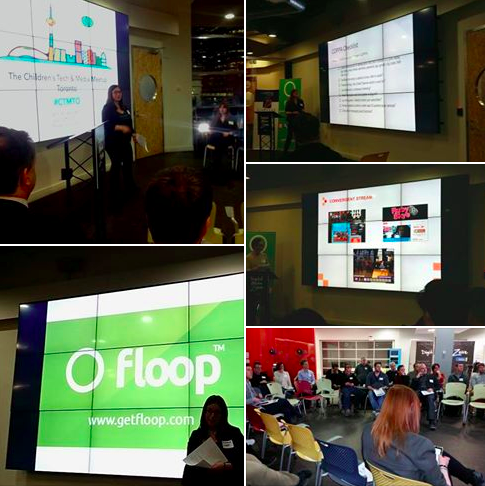
Given that there are unique legal considerations for digital content aimed at kids – as well as usability considerations – Montreal software developer Floop was showcasing its suite of services that help developers of kids iOS apps. For instance, iOS apps designed for children must have “parental gates” that ensure that children don’t access age-inappropriate content within the app or outside of it. Floop provides an SDK that makes it easy for developers to add parental gates, but also add kid-friendly video, ads, and links to other games all within the app. This ensures that children have a selection of content to view without being exposed to the wider (and scarier) internet.
3. We’re Reminded that Privacy Is in Our Hands (to a Certain Extent)
On Wednesday, Mozilla’s Webmaker initiative launched “Private Eye”, a tutorial that shows web users (ie. everyone) who might be tracking them online.
“From knowing what sites are tracking your clicks to what data you’re giving away, understanding online privacy is a critical issue,” writes Webmaker Community Manager (and former Torontonian) Amira Dhalla.
By way of the Firefox Lightbeam plugin, Private Eye helps show what third-party sites are tracking your online activity in addition to the sites you actually meant to visit.
While the government’s involvement in data collection remains abstract and unclear, and businesses struggle to incorporate privacy into their apps, tools like the ones Mozilla builds help us understand the privacy implications of our own activity online, and ultimately help us make informed decisions.
In an effort to encourage a new generation of coders, web training company BrainStation is launching “BrainStation Academy”, a program aimed at Toronto-area youth in grades 9 to 12 with courses beginning in March.
Along with the announcement of BrainStation Academy, BrainStation is holding a free day of code (RSVP required) event taking place on Saturday February 7th, at BrainStation HQ (445 King St. W., Floor 3). This includes a free, three-hour crash course in front-end web development – essentially the basics of building websites.
But that’s not everything.
According to BrainStation’s announcement, “Students will hear from speakers in the Toronto technology space, including the lead developer from Shopify and manager at Twitter. Students will have the opportunity to network over beverages and snacks, but most importantly put together their very own webpage in just hours.”
Students to attend the free day of code are eligible to receive a $500 discount for BrainStation Academy courses.
There’s no word on the pricing of BrainStation Academy courses, but regular adult courses are typically $2,500 (or $2,200 if bought well in advance).
The Toronto Tech Meetup, a gathering drawing a couple hundred members of the startup community, convened on the 26th floor of the Price Waterhouse Cooper building for an evening that included drinks, food, interesting conversation, and five quick presentations.
You can check out the presentations which are now posted to YouTube. But here’s my quick summary of each.
Ken Ranger on the TTC Wifi Rollout
Ken Ranger is the force behind an initiative that is bringing connectivity to Toronto’s subway system. He’s head of BAI Canada, which he describes as a “tech startup within a pension fund” – a fund managed by the Canadian Pension Plan Investment Board.
His parent company, BAI, has been bringing wifi into transit systems in New York and Hong Kong, and now Toronto. BAI Canada is paying the TTC $25 million over 20 years for the rights to install and operate a network in underground stations under the TConnect brand.
Right now, several stations on the Yonge-University-Spadina line can connect to the ad-supported Wifi service at no charge (beyond TTC fare of course), and is a revenue generator for the TTC.
How good is the connectivity at the stations? Apparently very good. While above-ground networks often get congested due to user volume, “Below ground,” he says, “it’s sweet.” Because there’s nothing else down in the subway, customers can expect high and consistent speeds.
Ranger and his team installed kilometers worth of cabling and cellular capable equipment, which makes a future rollout of cellular services possible.
While it won’t do anything to reduce wait times for commuters, being able to use a wireless device will certainly make waiting less onerous.
SocialHP is a Service that Lets Companies Post on their Employees’ Social Media Accounts
People simply don’t trust companies as much as people they know. George Kobakov, VP Operations at SocialHP, says 84 percent of people trust recommendations coming from friends and family over all other forms of advertising.
Those who take to social media to promote companies – known as “brand ambassadors” or “brand advocates” – are vital to any company because they contribute “a certain level of trust and credibility” and “that trust factor is key to sales,” Kobakov says.
SocialHP is a service that helps employers tap into the potential for tapping into their employees’ sway over their friends and family. “We give businesses the ability to onboard their employees…and very easily share content on their behalf through Facebook, Twitter and LinkedIn,” he says. SocialHP offers “businesses the ability to leverage those personal connections of their employees in order to promote the brand or their products, or anything else pretty much.”
Kobakov continues, “When an employee opts into our application, they give us the ability to share content directly to their personal wall, Twitter feed, or LinkedIN on their behalf. So, if I post on your wall, it will look like you posted it. Thereby in the eyes of your friends and family, it will look like you’re the one that’s genuinely saying, ‘Hey guys, you should check this out.’”
Matt Himel on Getting Hired at a Startup
For someone that was once lured into a predictable career in law, Matt Himel has always had an entrepreneurial streak. While writing the Ontario Bar Exam, he noticed a lack of study materials and came up with the Ontario Law Exam, a wildly popular source for practice material for law students attempting the bar.
But he also successfully transitioned from being a lawyer at a top Toronto firm (Davies Ward Phillips & Vineberg LLP) to being hired as a Growth Manager at Tilt, a startup aimed at helping people group their money more easily.
It’s not easy to quickly switch gears, yet Himel was happy to offer some tips, including how to make your application stand out and show your character.
For instance, he says he included his fraternity membership on his resume. “Funnily enough, when I interviewed with different tech companies and startups, they actually loved the fact that I was in a fraternity,” he says. “They saw things like camaraderie or building friendships with new people as things that are really important when you have an open workspace, and a small team. So don’t always think that things on your resume get overlooked – it’s important to sell your story a little bit.”
He also mentioned that he was an accomplished golfer. “They saw it as something that you’re really committed to, that you’re willing to work hard at, and they thought that that’s a really good character trait.”
While interviewing at startups, Himel said that he was often asked what books he was reading, and that having a good answer (such as Peter Thiel’s Zero to One) can help show your commitment to personal growth and learning about an industry. In fact, jobs applicants should read books and blogs on the industry they want to work in, and use the product or service that you’re interviewing with. It can also help to meet with successful people (not wannabes) and people who have the job you want.
He says that asking about money could make the employer question the recruit’s true career priorities.
To do well in an interview with a startup, it might even be more important to show your commitment level as opposed to your skill level. “Sell them on the fact that you’re really committed to making sure their startup is going to be a success – it’s not, come in, punch the clock and get out of there – it’s come in and really think hard about making the startup a success.”
However, he mentions that it’s not all about commitment – it does help to be a “master of all trades.”
John Philip Green on Growing CareGuide
John Philip Green founded CareGuide, a series of websites that connect people with a local caregiver – whether it’s a babysitter, nanny, eldercare specialist, dogsitter, or housekeeper.
In fact, CareGuide has seen such amazing growth over the past two years that a seed financing round in the fall raised more than $1 million among no less than 50 investors on AngelList, and broke the platform in the process. The company inadvertently exposed a code error because it wasn’t expected that the platform would have to handle so many investors.
What is the million-dollar idea? “We match families with caregivers,” Green says. “So, if you were looking for a housekeeper, you’d go to housekeeper.com.”
It’s exactly what you’d expect when you get there.
There are now hundreds of thousands of listings across cities in Canada and the U.S. But it wasn’t always that way.
Instead of proving a concept in one market like Toronto or San Francisco then moving it laterally to different cities, Green opted to have local markets available for local people to find and populate.
He started with a database of all the cities in Canada and the U.S., so it was a matter of getting people in various locations to make the platform useful, even when there wasn’t anyone local on the platform yet. “What we did was show a backdrop of listings, and overtop of that we’d have a modal dialogue box that requires you to sign up before you were able to access the listings – of which, well, there weren’t really any of them. But then they created the first listing.”
People search for help in obscure cities where no one else has signed up yet will see that same modal.
It might, however, come as a disappointment that CareGuide doesn’t do more than Craigslist to ensure that its caregivers can be relied upon to be safe and qualified. Like many things online, CareGuide requires a certain level of blind trust.
“How do we control the quality? Right now, we haven’t been that ambitious. We are a matchmaking service; we allow people to express themselves through their listings; they can validate their phone numbers, and email address, they can get social proof on the site – but we don’t go beyond that. In the same way that Craigslist wouldn’t be responsible for the connections that it makes between supply and demand.”
One of the “hacks” that Green said helps is starting with great domains. For instance, thousands of people would come to a domain like “sitter.com” even if there isn’t a service there. He calls domains “prepaid marketing.”
He also recommends not excessively developing a concept or focusing too much on features.
“I feel stongly that startups over-develop their product when they first begin. I’m proud to say that careguide websites…have six functional pages… we don’t even have background checks. We don’t do anything yet. We’re going to get to all of that… The thing you need to be focusing now on is distribution and growth.”
Green also advises against going overboard with public relations – at least in the early stages.
“PR – I can’t stand it. I think that most startups spend entirely too much time doing PR,” he says. While he has told his story to a few tech blogs, he thinks this is time and effort better spent elsewhere. “Startups need to focus a lot more on growth hacking, creating viral loops on creating their core drivers of their business, and not be so focused on the linear growth aspects of their market.”
He says that one of his strategies for finding investors was to ask for introductions to investors from other investors. Showing that you’re shopping the business around can creates an incentive for investors to act quickly – or it might help you find the right investor through networking.
Either way, CareGuide was attractive since it was cash flow positive. And while investors might have biases – it’s really about for instance, wanting to see mobile or social .
With a background in Computer Science and mathematics, Green said he was able to build most of CareGuide by himself. And while the relatively small size of his operation might turn off some investors, this is ultimately something that shouldn’t affect its ability to get funding and generate revenue.
“People have these biases when they’re investing… They have these preconceived notions about what a founding team looks like, what a successful business looks like. But guess what? If they really knew what a successful business looked like, they would go and build it. I’m building it.”
Eva Wong Says to Borrow Well, but Within Reason
Eva Wong says, “If you want to pursue your dreams, live below your means.”
She should know. She’s one of the founders of Borrowell, a platform that matches borrowers with institutional capital providers.
“I feel like the reason we were able to even pursue this [project] is because we were able to take either no salary or a small salary for [a] few months,” says Wong, who is Borrowell’s Chief Operating Officer. “I don’t think it’s a sacrifice – there are many great things about simple living.”
More generally, a high-priced lifestyle might not only cost you money, but it could mean you can’t afford to take your dream job because of mortgage payments, private schools, and other costs. “Living below your means,” she said, “means not having to adjust your lifestyle to do whatever you want.”
However, the reality is that Canadians are living with huge amounts of debt. Either by choice or by necessity, many Canadians need to borrow money to live. And the current options for lending often involve high rates and are inconvenient.
When it launches this quarter, Borrowell will use an online engine to quickly perform credit and fraud checks that help determine a borrower’s risk level – which affects their interest rate (from 6 percent to the low 20s) and available credit (to a maximum of $35,000). So, just like with car insurance where better insurance rates are available to drivers with good records, Borrowell wants to give better rates to those with better credit.
Borrowell is different than online “payday” lenders (online equivalents of MoneyMart, which charge exorbitant fees even compared to credit cards) and the only similar company in Canada is Vancouver-based Grouplend.
Still, Wong’s advice is avoid having to borrow money – and if you do have to borrow money, make sure that you get the best rate possible.
Numerous companies will be showcasing advances in the AR and gesture technology at Immersed, a two-day conference organized by The Immersive Technology Alliance. This will be a great opportunitiy to learn more about these emerging technologies, and how they relate to applications such as video games, immersive cinema, health, and more. It’s also a great opportunity to professionally network and build new relationships.
Who: Virtual Reality, Augmented Reality and 3D professionals
Where: 99 Sudbury, Toronto, Ontario
When: Sunday, Nov. 23 to Monday, Nov. 24.
It’s free to attend the exhibit floor, but the entire conference including sessions is $449.00. For a limited time, use the “gettingimmersed” coupon for a $200 discount.
Speakers include:
John Gaeta (Academy Award winner, Creative Director for New Media and Experiences, Lucasfilm);
Habib Zargarpour (Creative Director, Microsoft Studios);
Mary Spio (President, Next Galaxy);
Neil Trevett (President, The Khronos Group, VP at Nvidia); and
David Nalasco (Senior Technical Marketing Manager, AMD).
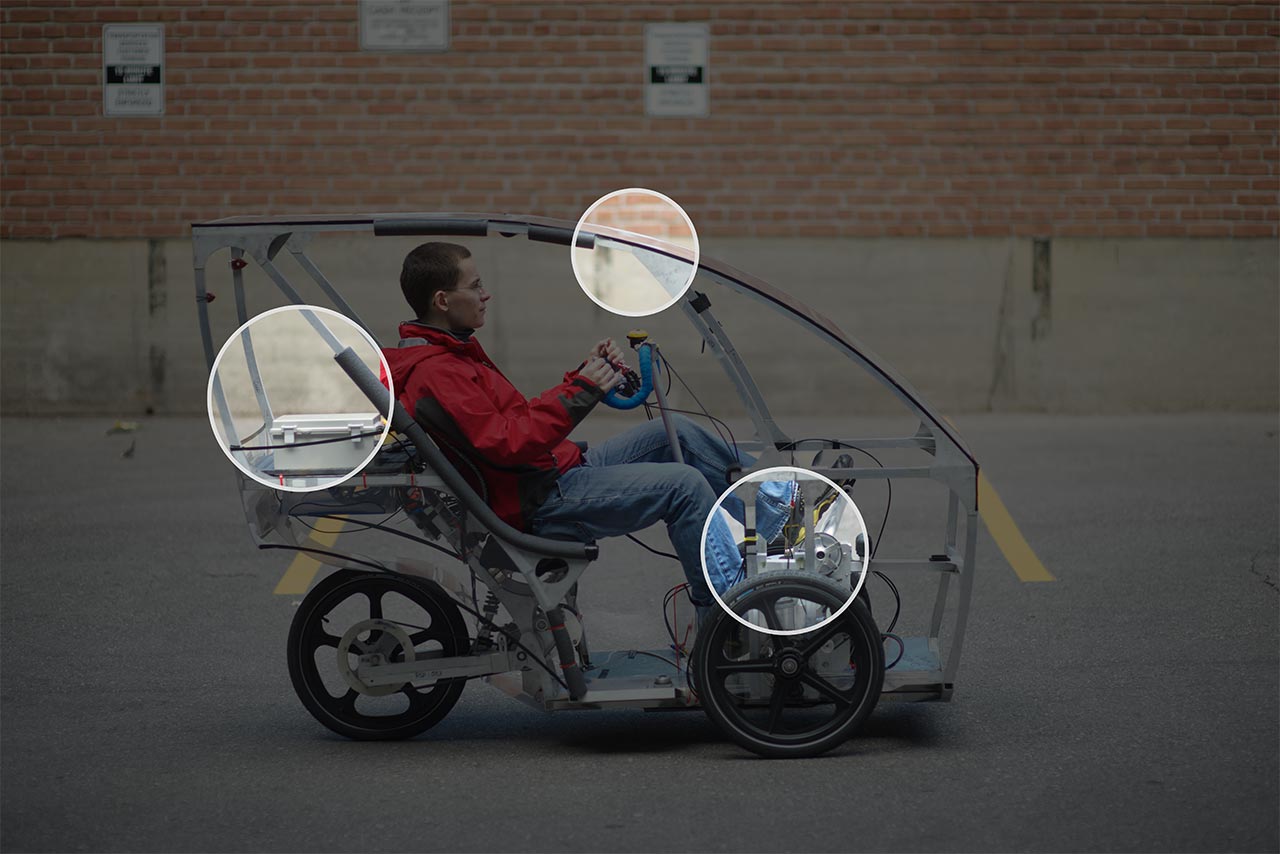
University of Toronto PhD students Phil Lam and Jonathan Lung have spent 18 months designing and building the prototype of a electric vehicle designed for urban transportation – but it’s neither a car nor a bike. Think of it as a “car-bike”.
Right now, the prototype has three wheels, an enclosure provides some shelter from the elements, and a seat for a single person. The electric motor that propels the vehicle (at a maximum speed of 32 km/h) can be plugged in to charge, or the driver can pedal to charge a battery. Eventually, they plan to add to the original design with a solar array to charge the battery and the option of having a second seat.
Lam and Lung are pursuing this project under the name “Sojourn Labs”, which is supported by U of T’s Impact Centre, a program that has been helping students, researchers, and industry collaborate on technology startups for the past five years.
The pair hopes to land a six-figure investment to turn this prototype into a commercially available product in the next year or two.
In an interview with the Toronto Star, Lam said the vehicle “combine[s] the benefits of driving a car with all the good things that come with riding a bicycle.”
While the price of the vehicle is not disclosed, affordability is one of the major considerations. In terms of classification, the vehicle is technically an e-bike, meaning that drivers won’t need registration, a licence or insurance, which keeps costs down and avoids barriers to would-be drivers.
Given Toronto’s beleaguered transit system, legendary gridlock, and various dangers to cyclists, it would be interesting to see if this ‘car-bike’ will provide a useful addition to the urban transportation mix.
Pictured above is the 26-year-old founder of Love Winter, Polina Roufanova, modeling the Valenki boots (pronounced va-LENG-kee), which merge traditional 300-year-old Siberian footwear design with modern styling and materials. They’re essentially a tall wool felt slipper with rubber galoshes that clip on. They’re designed to brave a cold (and slushy) Toronto winter, but then convert into versatile indoor slippers just by taking off the galoshes.
This is perhaps the perfect example of the creativity shown at Toronto’s Startup Fashion Week, a three-day long meeting point of fashion, technology and business which is ending today.
The event has featured presentations and panels on topics relating to an emerging world where technology influences fashion. It also seems like a great place to learn about trends in the areas of retail-tech, fashion-tech and wearable-tech, and presents some great networking opportunities for entrepreneurs in fashion design and digital fashion startups.
Hang Loose Media Studios (28 Logan Ave.) will be the location of the closing runway show, “The Future of Fashion”, which starts at 7pm tonight, and is followed by an afterparty. (For 50% off, use promocode: Launch50).
VANIKA, which bills itself as an independent label “rooted in a passion for biology”, is run by 16-year-old Vanessa Kiraly and seems particularly interesting, and undoubtedly represents the future of fashion.
As part of an initiative to support women in film and TV, producer Shasha Nakhai was given the opportunity to spend a week at Ubisoft’s Toronto office to learn the ins and outs of game production.
Ubisoft is, of course, the massively successful game studio behind the Assassin’s Creed and Far Cry franchises. However, it received a lot of negative attention when gamers could only play as a male character in Assassin’s Creed Unity. And with Far Cry 4, it (albeit narrowly) decided not to have a female playable character.
Meanwhile, general controversies such as “Gamergate” have revealed the frightening extent to which sexism is still a major issue in gaming.
Given this backdrop, it’s definitely important that gaming companies stop alienating women – who, by the way, make up 48-percent of all gamers – but also make a real effort try to get them to be involved in the gaming industry.
In a video from Ubisoft, Nakhai was given a warm welcome by the company, meeting with producers, programmers, creative directors, sound designers, and the motion capture team. While stereotypes are strong in the games industry, showing the different roles and diverse creative skills needed in modern games helps counteract the stereotype.
Nakhai said the games industry could be an overlooked opportunity for people trained in film and TV. “Even though you don’t have experience in the games industry, your skills can still be transferable,” she said.
However, to work in games, there are a few new things to get used to.
Nakhai said, “Game production seems to take much longer in development, and actually figuring out what you have in the first place. Whereas with a film, you have a script. You can read off the script and say, ‘This is going to be a good movie.’ And in gaming you don’t actually know that until you’ve actually tried it out.”
“We have sensors that track our sleep. We have sensors that track our steps. But there’s something that’s really missing,” says Ariel Garten. “Something that really determines how well you sleep, how many calories you burn, how good you feel the next day. And that’s what goes on in your mind.”
Garten is the CEO and co-founder of InteraXon, the Toronto startup behind the Muse brain-wave sensing headset which just launched in Canada after six years in development. Garten and fellow InteraXon team members were at the MaRS building on September 25 for the official Toronto launch of Muse.
Muse is a unique device that slips on like a pair of glasses. It has five electroencephalography (or EEG) sensors that record the brain’s electrical activity. This data is fed into the user’s mobile phone, which can determine the individual’s level of relaxation and focus.
While there are many potential uses for this technology, the headband is currently used as a form of assisted meditation. Tellingly, it is sold at Canadian bookstore chain Indigo, and through yoga and wellness brand Gaiam. Unlike austere mindfulness exercises, however, it makes a game of mental relaxation.
There are new games in development that feed on brain data, but the standard Muse game, “Muse Calm,” places the user on a beach. When they are calm, the user sees a peaceful beach on the screen. However, as mental disturbances enter the mind, the user will see waves form and the wind pick up.
The Muse Calm app is designed to guide users to mental calmness.
InterXon had originally intended for its brainwave sensor technology to help people interact with the physical world. For instance, it had created a chair that levitates and a version of the addictive “Ktarian game” featured in Star Trek TNG. During the 2010 Winter Olympics, InterXon took it to another scale, allowing people to control the lights of the CN Tower, Niagara Falls and the Parliament Buildings with their minds.
[aesop_content color=”#ffffff” background=”#333333″ columns=”1″ position=”none” imgrepeat=”no-repeat” floaterposition=”left” floaterdirection=”up”]Developers interested in using Muse as a way of adding brain input to their applications have a set of tools available to work with Muse.
[/aesop_content]
Yet, when it came to building Muse, the focus was not on experiencing something physical, but rather teaching the mind how to be calm and focused. And this seems especially appropriate given the constant barrage of email, phone alerts and online curiosities that make it difficult for many of us to unwind.
In a public discussion with WeAreWearables founder Tom Emrich, the team behind Muse discussed the design considerations behind Muse and the accompanying Muse Calm app.
Given the backlash against products like Google Glass, wearable technologies need to be mindful that their design doesn’t rub people the wrong way. Garten, who has a background in fashion design, explains, “For us it was very important to make something that was a fashion item – something that you felt comfortable walking down the street wearing, so we did extensive user testing.”
While her original conception was something that looked more futuristic and asymmetrical, testers didn’t like these sorts of prototypes. “The feedback we got was that people liked things that are symmetrical, they liked things that were balanced. Things that looked like something they already had.”
The simple headband was it.
[aesop_image imgwidth=”100%” img=”http://labto.wpengine.com/wp-content/uploads/2014/09/vlcsnap-2014-09-29-21h27m39s86.png” align=”left” lightbox=”on” caption=”On stage at We Are Wearables meetup at Toronto’s MaRS Discovery District. From Left: Raul Rupsingh, Jay Vidyarthi, Trevor Coleman, Ariel Garten.” captionposition=”right”]
Next, it was important to create an interaction within Muse Calm that subtly helps users reach a state of restfulness, without disrupting their calmness.
“People needed a way to experience the technology,” says Interaxon co-founder and Chief Product Officer Trevor Coleman.
He came up with the “metaphor” of the beach when thinking about a Zen koan: Basically, two monks were looking at a flag blowing in the wind. One said the flag was moving, and the other said the wind was moving. Unable to agree among themselves, they asked the Zen Master who said, “only mind is moving.”
Advanced users will find that, if they are very still, birds would come. This was an element added by Jay Vidyarthi, InteraXon’s senior interaction designer, who saw the birds being another element of feedback that people found useful. He explains wanting and not wanting the bird in the video below.
There’s no doubt that hearing people talk about the experience of Muse makes you think – what are they smoking? But it might just be because we’re so unused to technology helping bring us – for lack of a better term – enlightenment.
Coleman, however, notes that Muse isn’t a quick fix or an “instant meditation machine”. He sees it more like a treadmill. It helps you work on a specific aspect of yourself, but you have to put effort into it.
“When we looked at this as a way where we could get people to actually improve their lives, I think giving people information is important, but you’ve got to give them something actionable that they can do,” he says. “With this interaction specifically, people sit down, they engage with us.”
Garten, who is the supernaturally calm and focused like a yoga instructor, says meaningful change can come about through how one thinks and feels about the world.
For instance, one customer is a woman who uses Muse to deal with the stress of her husband’s cancer. The relaxation exercises helps her be a more supportive partner, and kinder to the people around her despite her unfortunate situation.
Gaten sees this as “an opportunity to allow people for the first time to understand their own mind, and use that information to improve themselves.”
This shrunk-down and stylish EEG sensor also has the potential to draw from a large source of anonymized data, which could help researchers better understand stress symptoms in the general population, not just from lab tests.
Depending on your perspective, this technology could be exciting – or calming.